Industry

Healthcare

Client

Invisible Care

Duration

8 months

Role

Design Engineer

CarePrompt

CarePrompt

An AI agent to support Personal Support Workers (PSWs) with centralized resource, smart recommendation, and effortless client management, empowering them with confidence and efficiency.

Background

Background

InvisibleCare is a virtual healthcare company that has supported over 1,000 clients with a team of 17 Personal Support Workers (PSWs) under a single Occupational Therapist (OT)’s supervision. As the service scales, leadership aims to integrate AI into the PSW platform to improve efficiency and consistency, while not compromising on the quality of care.

Mixed-method

Mixed-method

Research Approaches

Research Approaches

4 User Interviews

4 User Interviews

with PSWs

with PSWs

3 Shadowing Sessions

3 Shadowing Sessions

with PSWs and OTs

with PSWs and OTs

1 Role-play Workshop

1 Role-play Workshop

with 24 students in 6 groups

with 24 students in 6 groups

Insights

Insights

Poor Resource Organization

Internal image library are rarely used due to poor organization and incapability of cross-referencing.

Ineffective Search

Limited search capabilities make it hard for PSWs to quickly find the information they need.

Over-Reliance on OTs

PSWs have a habitual reliance on OTs for confirmation, which increases response times and reduces message frequency.

Design Direction

Design Direction

Instead of relying on one-on-one guidance, we aim to empower PSWs with an AI-powered resource tool, which is centralized, searchable, and easy to update.
Design Iteration

Design Iteration

Testing & Refinement

Testing & Refinement

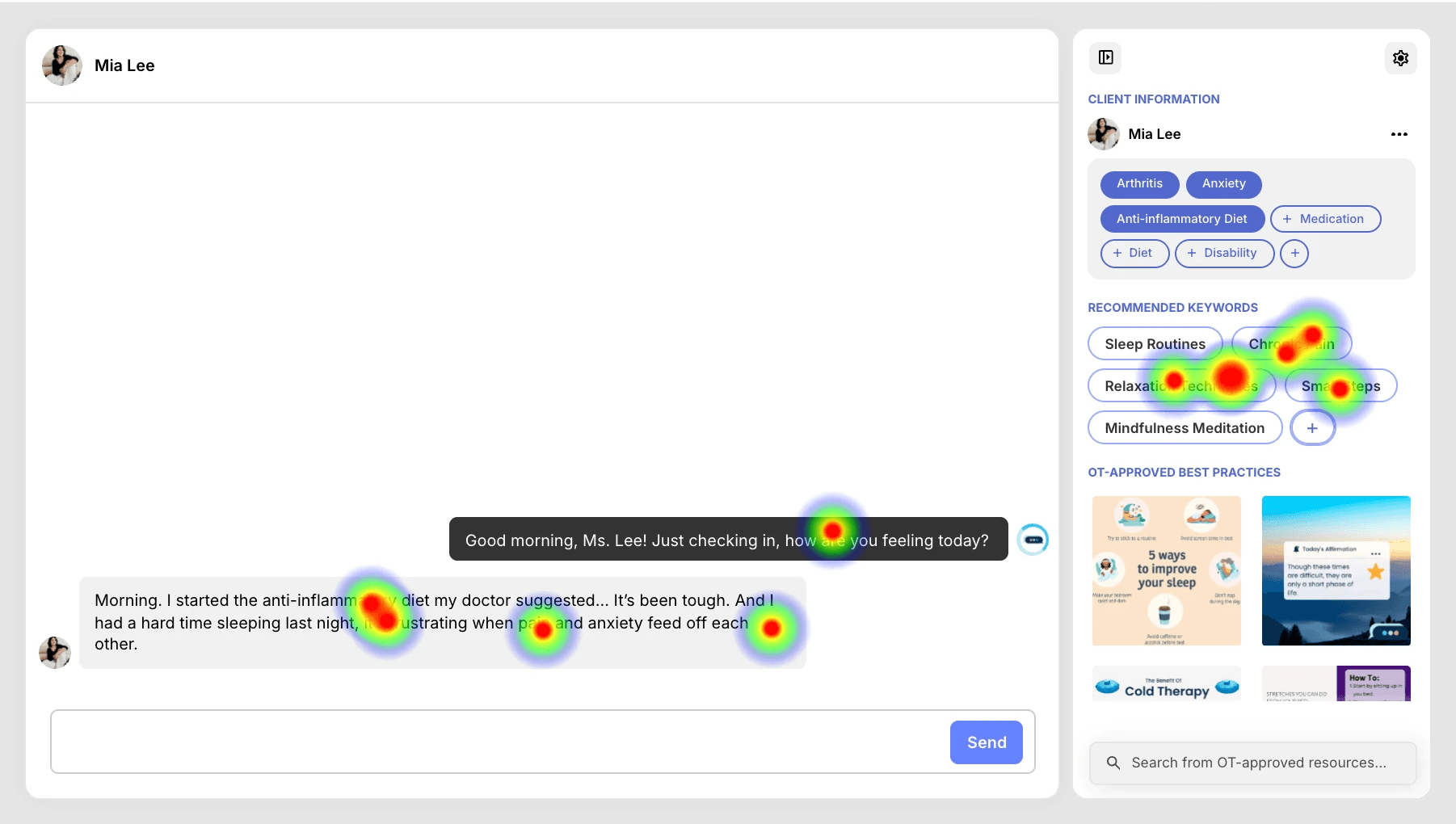
We conducted unmoderated usability testing in Maze with three tasks. The “Search and Select” flow particularly revealed a number of potential areas for improvement.
Alternative Images

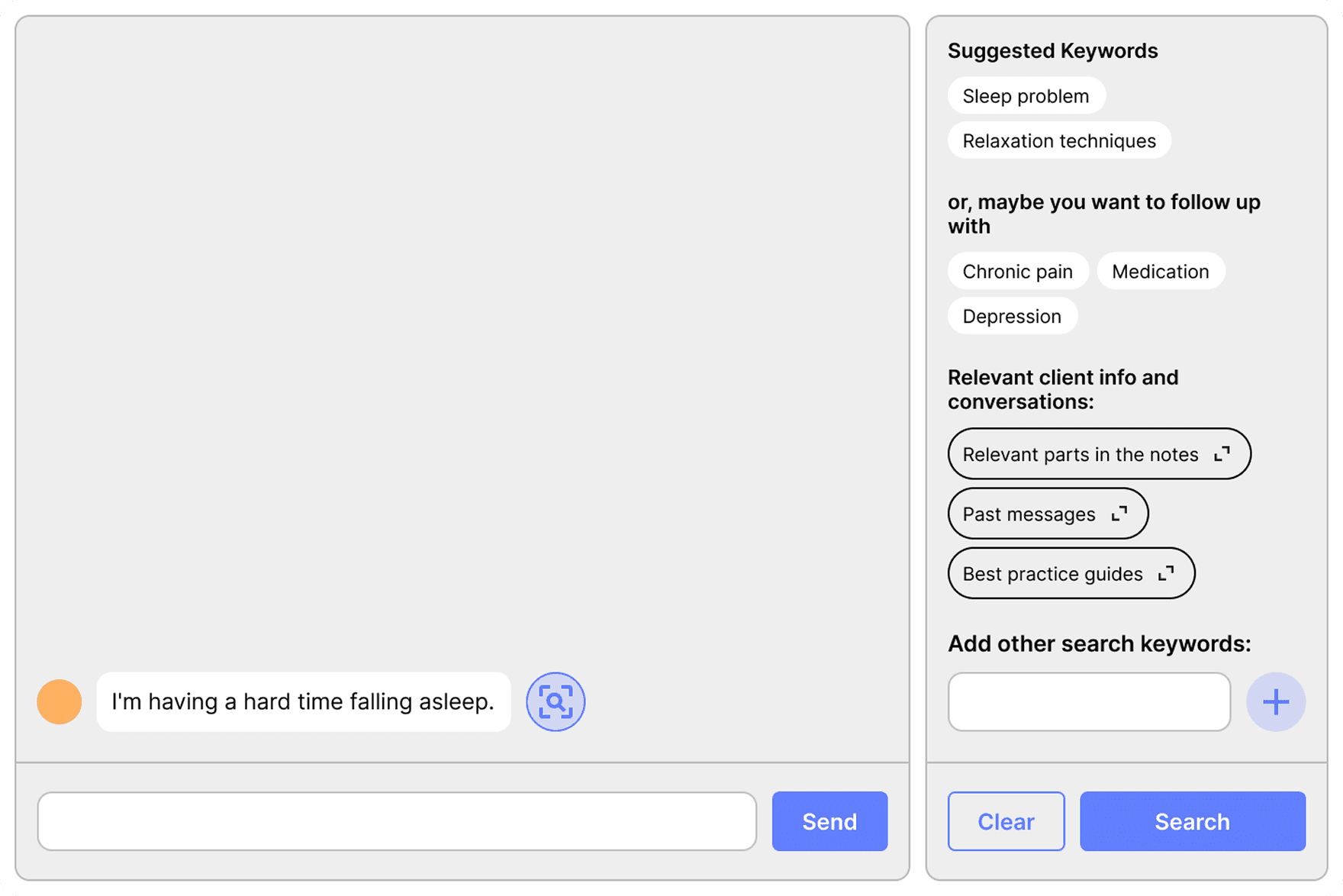
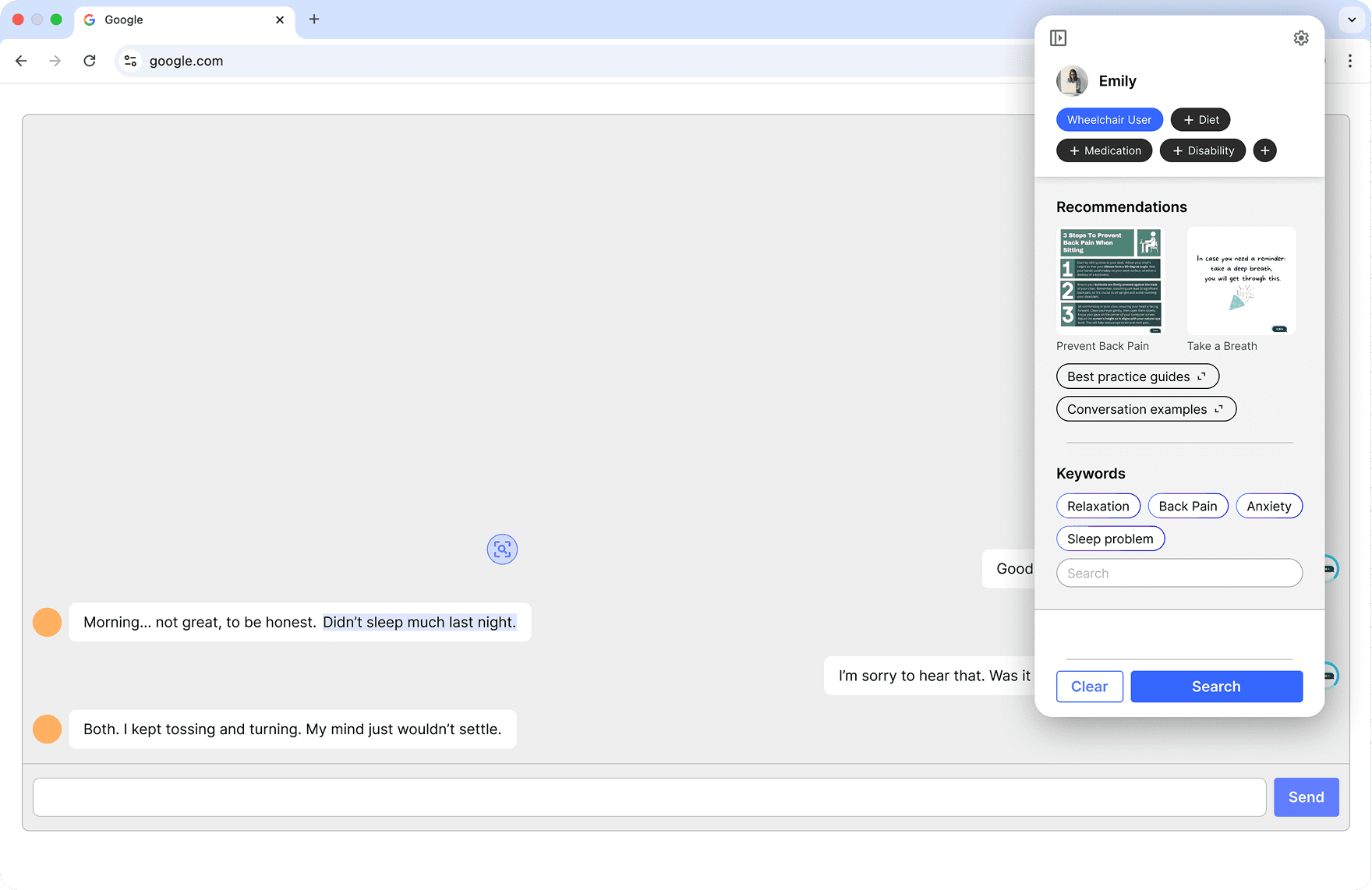
Users want access to the full image library when retrieved results fall short. To support this, a manual search feature allows for more precise filtering and targeted results.

Hover Dependency

Hover-based interactions reduce discoverability, particularly for new users. So a sticky button is added next to client messages to surface available actions more clearly.


Prototype

CarePrompt - Empower PSWs with informed decisions

Client Snapshot

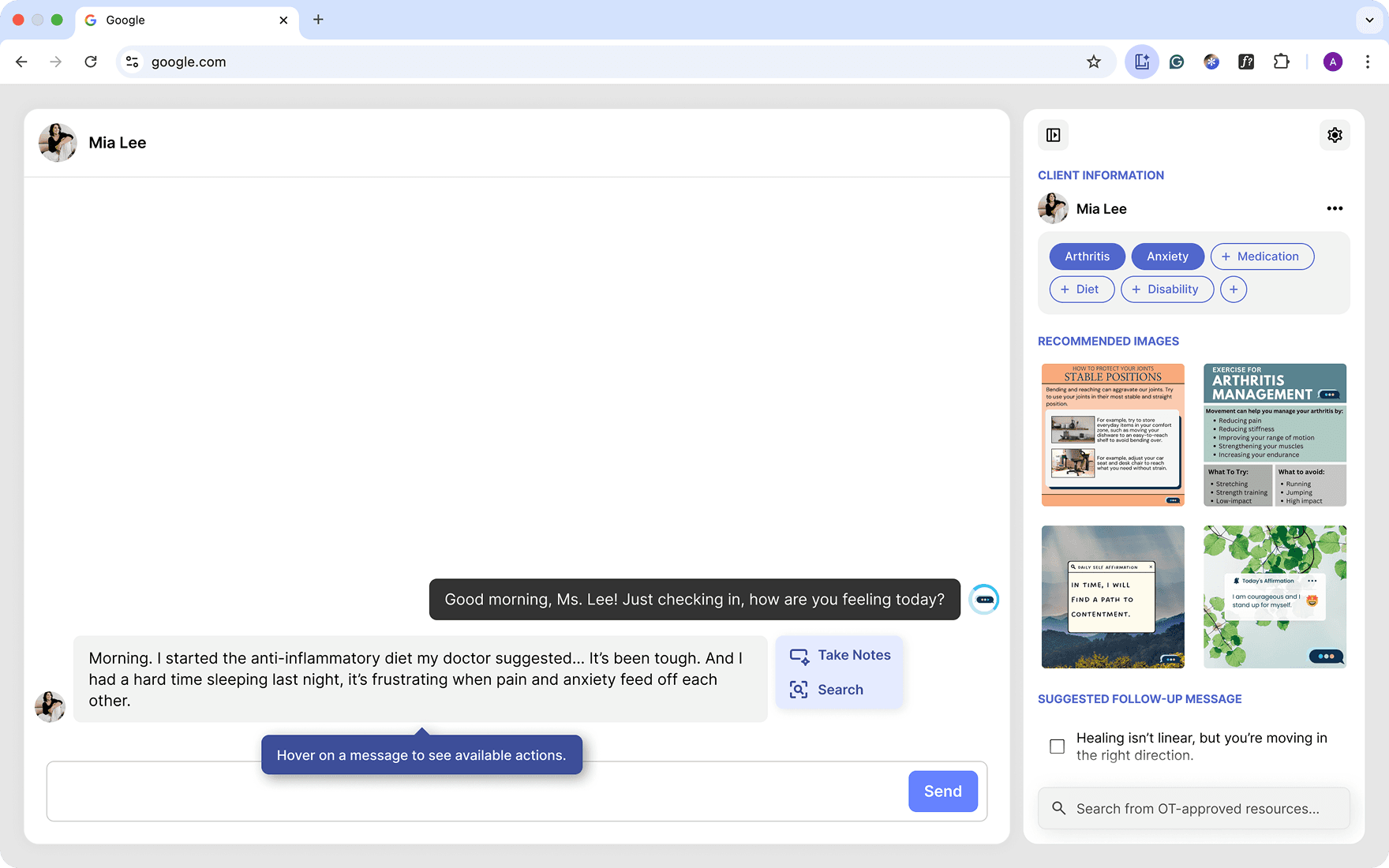
Generate a Client Snapshot that captures key context and persist across shifts—reducing handoff effort and cognitive load for PSWs

AI Image Selection

Uses client messages and snapshot context to suggest relevant images from a centralized library for faster, more contextual support.

Manual Search

Allows PSWs to manually search and filter the image library as a fallback, enabling more precise and targeted results when needed.

Prototype

CarePrompt - Empower PSWs with informed decisions

Client Snapshot

Generate a Client Snapshot that captures key context and persist across shifts—reducing handoff effort and cognitive load for PSWs

AI Image Selection

Uses client messages and snapshot context to suggest relevant images from a centralized library for faster, more contextual support.

Manual Search

Allows PSWs to manually search and filter the image library as a fallback, enabling more precise and targeted results when needed.

Prototype

CarePrompt - Empower PSWs with informed decisions

Client Snapshot

Generate a Client Snapshot that captures key context and persist across shifts—reducing handoff effort and cognitive load for PSWs

AI Image Selection

Uses client messages and snapshot context to suggest relevant images from a centralized library for faster, more contextual support.

Manual Search

Allows PSWs to manually search and filter the image library as a fallback, enabling more precise and targeted results when needed.

Python · Flask · OpenAI API

Coded Prototype

Coded Prototype

A coded proof of concept was developed to simulate live product performance, leveraging Python, RESTful APIs, and prompt engineering to optimize processing efficiency and response quality. The prototype enabled realistic user testing and provided actionable insights to support stakeholder decision-making.

Why Code?

• Needed realistic AI responses
• Needed actual API latency
• Needed testing beyond Figma

Impact

• Reduced uncertainty during concept validation
• Supported stakeholder buy-in
• Informed future product requirements

Reflection

Reflection

In this project, I collaborated with diverse stakeholders to design an AI-mediated assistant for Personal Support Workers, integrating image retrieval, recommended messages, and note-taking. The process highlighted the importance of teamwork, role clarity, and evolving confidence as students took greater ownership. Engaging directly with AI as a design material reshaped how I approached user-centred design, requiring me to balance technical feasibility with user trust. Personally, I learned to design with users rather than for them, adapt within complex collaborations, and embrace steady, empathetic iteration, which has shaped me into a more reflective and adaptable designer